From Paper to Cloud: How Neksus ERP Changes the Way Companies and Accountants Work Together
Paper, emails and double data entry slow down both the company and the accountant. How working in the same cloud ERP brings accuracy, speed and real-time visibility.
I. The problem with the old way of working
A large number of companies and accounting agencies still operate on an outdated principle – paper, emails, USB sticks and endless Excel files. The same scenario repeats every month: the company emails its invoices, the accountant downloads them, enters them into the software and then sends back questions and requests for missing documents. This process is slow, inefficient and error-prone.
1. Manual entry and double work
The company already has the data in its own system, yet it still has to send it to the accountant. The accountant then retypes that data by hand. One wrong digit and the entire calculation has to be unwound. The result? A huge waste of time and frustration on both sides.
2. Decisions “in the dark”: delayed data and poor communication
The key problem that creates tension is the lack of timely insight into the financial position. Without a centralized system, the business owner loses control: they do not know exactly which suppliers they owe, when those liabilities fall due, or which customers still have not settled their debts. The accountant has that information, but only after manually processing the documents – often with a delay of several days or even weeks. Management keeps asking for up-to-date reports, while agencies face pressure because they cannot deliver them immediately. In the end, companies make important decisions “in the dark”, without a clear picture of their cash flow.
3. Inconsistent data and frequent errors
Because different programs are used, documents often do not match: the invoice number differs, the amounts do not add up, VAT returns have to be corrected. On top of that, regulations change, and outdated bookkeeping software often fails to keep up with changes in law and standards.
4. Limited access and dependence on the accountant
Documents are locked away in the office. If someone at the company needs information, they have to call or write to the accountant. If the accountant is unavailable – everything stops. Communication relies on emails and phone calls, which makes it even harder to keep track of records and change history. This way of working can no longer meet the needs of modern companies that operate in real time.
II. The advantages of the new digital model – collaboration in the cloud
Digital transformation is revolutionizing the relationship between accountant and company. In the new model, the company runs the operational side of the business while the accountant supervises, controls and professionally processes the data. Everything happens in the same, connected system – a cloud ERP.
1. The company runs its own business – simply and clearly
Through a modern ERP system, the company can independently:
- Enter incoming and outgoing invoices
- Record payments and receivables
- Track inventory and costs
- Access reports and charts in real time
- See receivables and payables to suppliers at any moment
The company thus has full insight into its finances without waiting for the accountant. If management wants to know the receivables balance or how much it owes a particular partner, it sees everything immediately – in real time.
2. The accountant as a business advisor
In a digital environment, the accountant is no longer a “data entry clerk” but a controller and advisor. Instead of retyping invoices, they focus on:
- Analyzing business results
- Checking the accuracy of entries
- Posting and year-end closing
- Advising management on optimizing costs and investments
This changes the perception: it is no longer just about the technical side of bookkeeping, but about a partnership between the company and the accountant.
3. Working together in real time
When the company and the accountant are in the same ERP system, all data is synchronized. A user at the company enters an invoice and the accountant sees it immediately. The system automatically links the document to the customer, the account and the VAT category. If something is missing – it warns the user. The result: fewer errors, fewer delays and greater accuracy.
4. Cloud security and 24/7 availability
Unlike local programs, a cloud ERP allows access anytime, anywhere. All data is stored in secure data centers, with automatic backups and encryption. You no longer have to fear losing data or an unexpected computer failure.
- Available 24 hours a day, 7 days a week.
- Multi-layered protection and an activity audit log.
- Backups twice a day.
5. Efficiency and measurable time savings
By moving to a cloud ERP, agencies and companies achieve measurable results:
- Up to 70% less manual data entry
- Faster VAT calculation and posting
- Fewer errors in reports
- More time for strategic activities
Instead of spending days adding up numbers, accountants can plan and optimize the business of their partner companies.
III. Neksus ERP – the solution that connects the company and the accountant
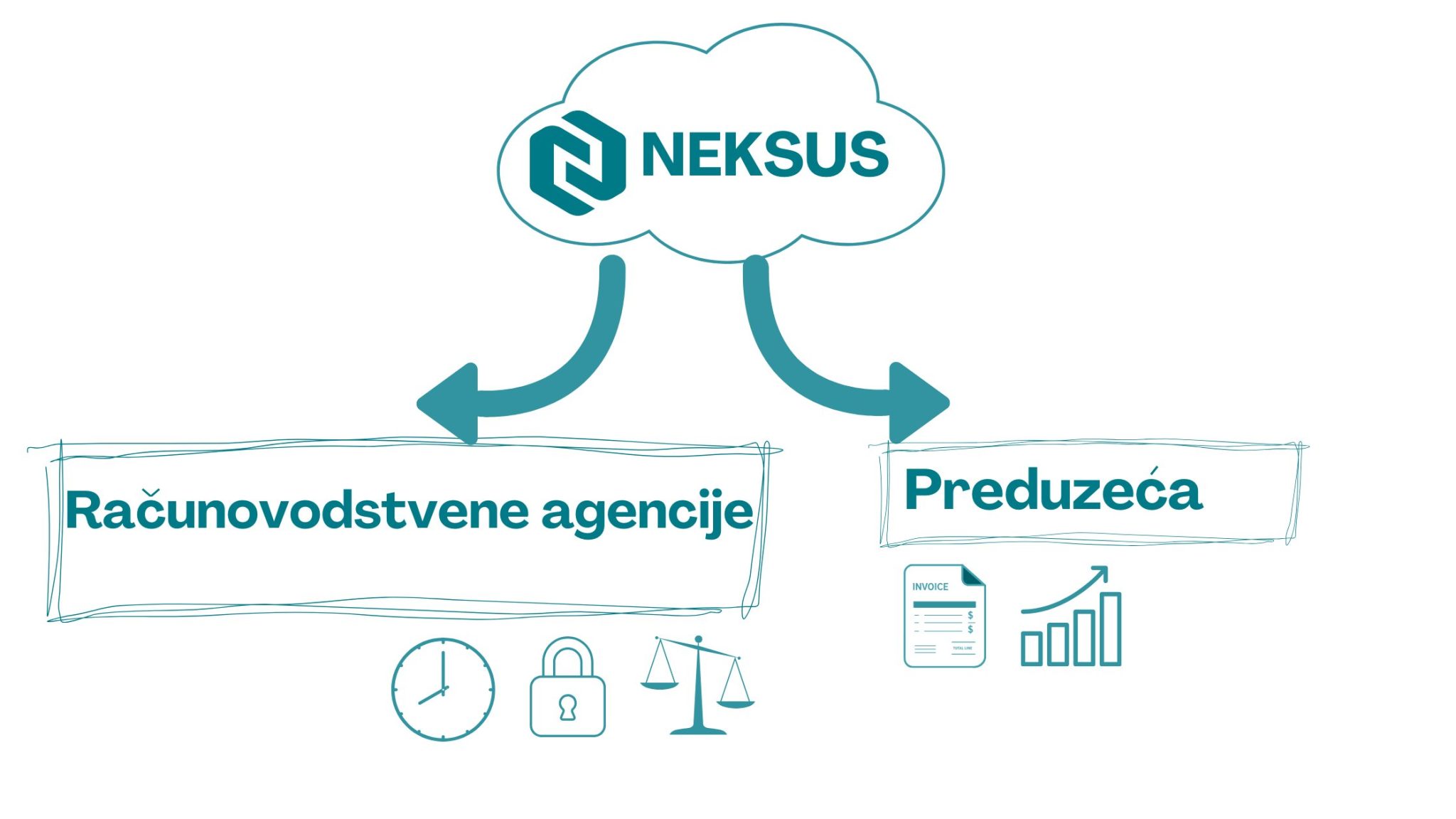
Neksus ERP is a locally developed cloud business system designed to bring companies and accounting agencies together on a single platform. Instead of exchanging emails and entering data by hand, both sides work in the same application – in real time.
1. Neksus from the company’s perspective
In Neksus, the company has full independence and control over its day-to-day operations:
- Enters invoices, payments and expenses
- Tracks payables and receivables
- Creates quotes, delivery notes and goods receipts
- Monitors VAT and liquidity
- Reviews turnover reports and balance sheets
When management needs information about receivables, payables or a balance, it does not have to call the agency – it simply opens the application. This solves the key problem that burdened both sides for years: the company asks for a report, the accountant has to prepare it by hand, often late because of the workload. Now, thanks to Neksus, the data is available immediately and accurately.
Benefits for the company:
- Runs its own operations independently
- Always knows the company’s financial position
- Makes decisions quickly
- Reduces costs and paperwork
- Has accurate information on receivables and payables at all times
2. Neksus from the accounting agency’s perspective
In Neksus, the accounting agency has a centralized overview of all the companies it manages:
- Checks entries and posts documents
- Automatically calculates VAT, payroll and depreciation
- Generates balance sheets and reports
- Controls the work of multiple users and tracks deadlines
The agency no longer has to download documents; everything is done directly in the system. This eliminates the need for additional programs and database synchronization.
Benefits for the accounting agency:
- No manual data entry
- All companies in one database
- Bulk calculations and postings
- Less pressure from companies asking for reports, because the system already provides them
- Greater efficiency and accuracy
3. Transparency and security
Every action in the system is recorded in an audit log – it is known who entered, changed or deleted a piece of data. This ensures full transparency and security of operations. Neksus ERP runs on ISO-certified infrastructure with data encryption to EU standards.
4. Fast implementation and local support
One of Neksus’s greatest advantages is that it was developed locally, for the local market. The system complies with the regulations of the Republic of Srpska, the Federation of BiH and Brčko District. Support is available in the local language, with a real understanding of bookkeeping processes. Implementation takes just a few days, and users receive training and assistance throughout the process.
IV. The digital future of accounting
Accounting and bookkeeping are no longer just about “closing the books”. Today they involve constant communication, analysis and strategic planning. Neksus ERP makes exactly that possible – an environment for digital accounting where data is accessible, processes are automated, and collaboration is simple and secure. When a company can track its own receivables and payables while the accountant sees every change in real time, a completely new level of business efficiency emerges. Neksus ERP is not just accounting software, but a platform for partnership between the accountant and the company.
Conclusion
The old way of working – emails, paper and manual entry – has become an obstacle to growth. The modern, cloud-based model of collaboration brings accuracy, speed and transparency. Neksus ERP connects accountants and companies in a single system that saves time, reduces costs and enables more efficient business.
Book a free Neksus ERP presentation and find out how digital collaboration can completely transform the way your agency or company works.